



“I need to get my message across, but nobody seems to be listening.”
It’s a problem that many of us can relate to, in one way or another. And it can feel like a dead end. The harder we try to be heard, the more forced and awkward the message begins to sound.
Sometimes it can help, though, to shift focus from the message itself to our own role as communicators. Because a communication of any sort involves a relationship between the speaker and the listener – so it’s really worth asking how those relationships might be operating.
In this blog, I’ll playfully outline some of the familiar roles adopted by those with messages – before proposing another approach to the relational situation. We call it ‘Listening for Action’, and it’s at the core of our work at Vesper Hill.

1. The Street Preacher
You know this role. It’s a favourite among firebrand evangelicals. They stand in the street with sandwich boards, shouting vague threats and promises. Shoppers mostly pass them by, pretending not to hear.
We’ve all seen this person. But if we’re honest, some of us have also been this person. If we’re passionate about what we know or believe, we can feel compelled to blurt out our news – good or bad – to anyone within earshot. Like a Dalek who just says ‘Disseminate!’
If I’m playing the role of street preacher, I’m not really thinking about building a relationship with listeners. And so other people usually won’t listen. And so I might be tempted to shout louder: ‘Look here! This is important!‘ Then, if they still won’t listen, I might just decide that the fault lies with them: ‘I am throwing my pearls before swine. They will never know the light.’ But blaming other people is always easier than looking in the mirror.

2. The Dad
Unlike the street preacher, this kind of speaker understands the need for relationship. But it’s a relationship in which they hold authority. And again, this role is all too familiar.
If you’ve worked for an organisation with power — like a government body, or a local authority, or a university – you’ll probably have needed to communicate organisational decisions to some of the people affected by them. If those people push back with questions – ‘but why?’ – it can be tempting to respond like an irritated parent: ‘because I say so.’
Obviously not all dads are like this. But there is an acronym – DAD – which stands for DECIDE, ADVISE, DEFEND. It has sometimes been used in governmental circles (yes, really), and it neatly sums up the patriarchal approach. First, we decide on something –without asking the people affected. Next, we advise them about what we’ve decided. Then, if they’re not happy about it, we defend ourselves by politely explaining why they’re wrong.
It’s easy to get sucked into role relationships of this sort, but acting the Dad is never a great method for building trust. It’s a method for treating other adults like children. And perhaps, in turn, for making them act that way.

3. The Cue Ball
In snooker or pool, when the cue ball hits another ball, there is an energy transfer between the two. The momentum of the first ball transfers to the second. If the cue ball has hit just right, the target ball goes straight into the corner pocket.
As communicators, it’s easy to imagine ourselves as cue balls. If I calibrate my message just right, then you will react to it just right. Cause and effect. You will go straight off and do the thing that I want you to do.
Except that you probably won’t – because you’re a flesh-and-blood person, not a snooker ball, and so you operate according to the laws of biology, rather than physics. Communication operates through stimulus and response, not cause and effect.
Put crudely, this means that if I poke you in the arm, you won’t immediately turn and poke the next person along. You might ignore me, or poke me back, or shout at me. Your response is basically unpredictable, and it’s for you to determine, not me. A lot will depend on your mood.
So I might want to consider context, before poking you. For example, are there things that I could say or do to maximise the likelihood of you responding to my stimulus in the positive, even playful spirit in which it’s intended?
 4. The Listener
The listener is the speaker who understands that – in any normal human relationship – we don’t just ‘message’ at people. We don’t just tell them about ourselves, and the things that we’re concerned about. If we have any social skills, we’ll probably start by asking the other person how they are. And then listening to the answer.
This might sound obvious, but it’s amazing how easily we can forget it. In fact, we can forget it so easily that, in political circles, the simple act of listening has recently been dubbed radical listening. Party activists are realising that, if trust is to be rebuilt with voters, then it’s important to find out what people really think about things – rather than just treating them as demographic data points with stereotyped opinions.
There’s lots of evidence, now, to support what we probably know instinctively: that if others feel you are listening to them, they’re less likely to feel irritated or angry by whatever you have to say to them. But more than that – if you understand more of what your listeners are concerned about, then you might need to recalibrate your own concerns, so that they land better with the people you’re talking to.
***
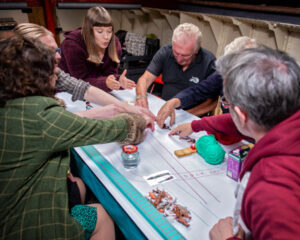
Listening for Action
At Vesper Hill, we look for ways to tell new stories about things that really matter –socially and environmentally. Typically, we’ve been commissioned to do this by an organisation that has something specific they want to say.
But we start, always, by listening. Listening to the client, obviously, but then listening also to their intended audience – whether that be engineers or bankers or schoolchildren. How do they look at things or feel about things? What kinds of stories or perspectives make sense to them? And what might the concerns of this audience have to do with the client’s concerns? Is there common ground to be found? Are there shared stories we can tell?
The great thing about a good story is that people will approach it from their own point of view. You’re not just telling them what to think – you’re inviting them to think about something for themselves, and to respond on their own terms.
That response remains unpredictable – yes – because that’s just how people are. But if you want to create the conditions for collective action, then building trust, consensus, and buy-in are essential parts of that process.
To do that, you need first to frame the story in ways that resonate authentically with your listeners. So why not start by listening to them?
***
Three photo images for this blog are freely licensed from Unsplash. The credits are due, respectively, to Ryunosuke Kikuno (preacher), Curated Lifestyle (dad), and Dan Burton (cue ball).